


Skincare
Oman’s Seasonal Change & Skin Health: Precautions for Kids and Adults
Simple skin-care precautions for adults and children in Oman as heat, humidity, air conditioning, and outdoor exposure change.
Proudly serving Oman · Happy 56th National Day
She is Oman · Happy Omani Women's Day, 17 October
Wait, before you go
Omani Women's Day · 15–17 Oct
Ends in
Before you check out
Add a small item and get free delivery:
How to protect babies and children from Oman's strong sun: shade for under-6-months, choosing a broad-spectrum SPF 30+, applying and reapplying it properly, and caring for sunburn.
Children in Oman spend a lot of time outdoors: school playgrounds, football after class, weekend picnics in the wadis and long afternoons on the beach once the weather cools. The sun here is strong for most of the year, and young skin burns more easily than adult skin. Sunscreen is only one part of keeping children safe, but it is the part many parents have questions about: which SPF, mineral or chemical, cream or spray, and how often to put it back on. This guide answers those questions in plain language, with tips that suit Omani weather and family life. At Avicen Online we have gathered the advice from trusted health sources in one place.
The UV index measures how strong the sun's burning rays are. A reading of 3–5 is moderate, 6–7 high, 8–10 very high and 11 or more extreme. Climate data for Muscat shows the typical daily maximum reaches around 11 from March to September, about 9 in October and still 6–7 in the cooler months from November to February. In other words, there is no month in Oman when children can safely skip sun protection.
Children's skin is thinner and more sensitive than adult skin, and the NHS notes that repeated sun exposure in childhood can lead to skin cancer later in life. The American Academy of Pediatrics (AAP) points out that around one quarter of our lifetime sun exposure happens during childhood and adolescence. Good habits now protect your child for decades. If you would like the bigger picture for the whole family, read our guide on why SPF matters in Oman all year round.
For young babies, shade and clothing come before sunscreen. The NHS advises that babies under 6 months should be kept out of direct strong sunlight. The AAP gives the same advice: find shade under a tree, an umbrella or the pram canopy, and dress your baby in light clothing that covers the arms and legs, plus a hat.
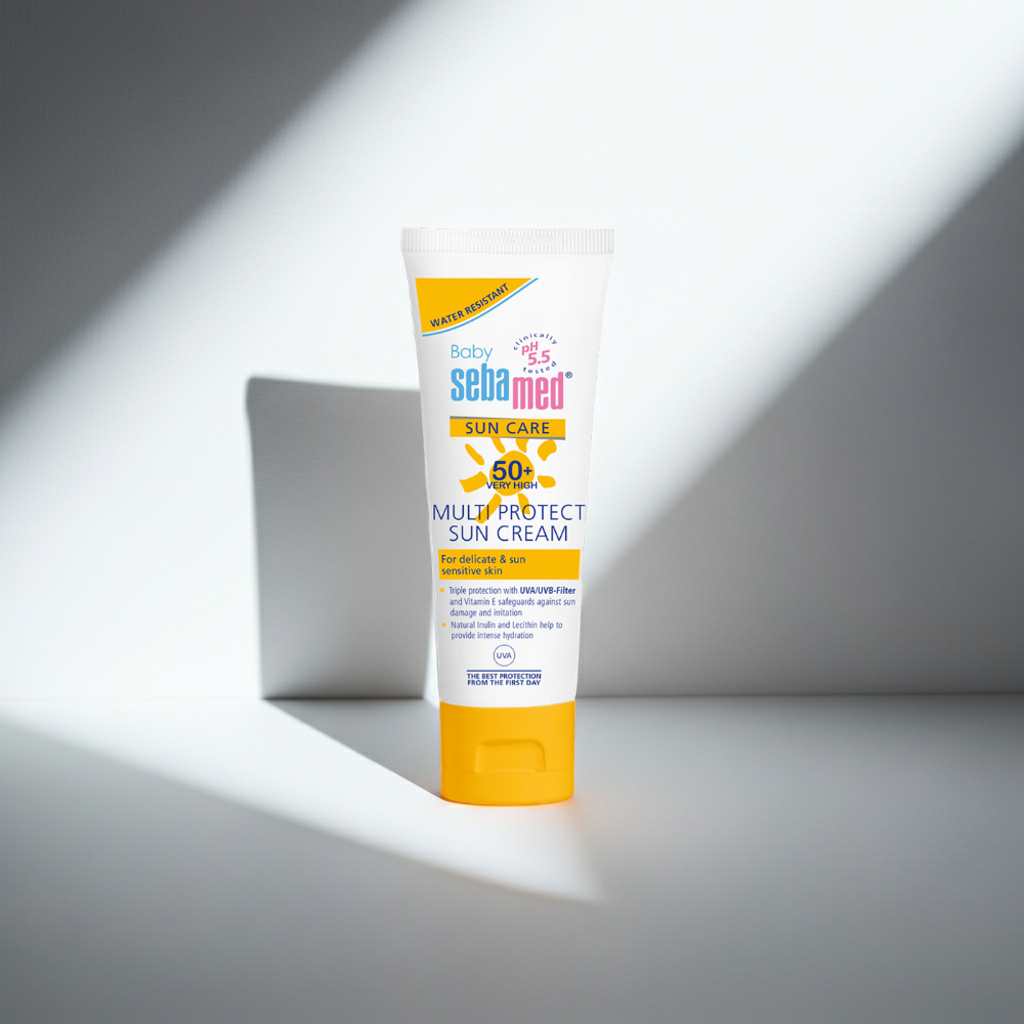
If shade and clothing are not enough, the AAP says a small amount of sunscreen can be used on small areas such as the face. Choose a gentle, fragrance-free formula and test it on a small patch first. Some baby sunscreens, such as Sebamed Baby Sun Care SPF 50+ Cream, use mineral filters (titanium dioxide and zinc oxide), which the AAP suggests for sensitive areas. Always check the age guidance on the pack and ask your pharmacist or doctor if you are unsure.
For more on caring for delicate newborn skin in the heat, see our baby skin care guide for hot weather.
From 6 months onwards, sunscreen becomes an everyday part of sun safety. When you look at the pack, check these points:
Mineral (also called physical) sunscreens use zinc oxide or titanium dioxide. Chemical sunscreens use organic filters that absorb UV. Both protect well when applied properly. Mineral formulas are often preferred for babies, the face and sensitive skin, and the AAP recommends zinc oxide or titanium dioxide if a sunscreen irritates your child's skin. Chemical formulas usually spread more easily and leave less white cast. The AAP also suggests avoiding oxybenzone where possible, while stressing that any sunscreen is better than none.
The best format is the one your child will actually let you apply. Each has its place:
You will find more options for the whole family in our sunscreen collection. Check each product's age guidance before use.
Most people use far too little sunscreen, which lowers the protection a lot. The NHS says an adult needs around 6 to 8 teaspoons to cover the whole body. Children need less, but the layer should still be generous. Follow these steps:
If a new sunscreen causes redness or a rash, stop using it, wash the area gently and try a different product, ideally a mineral one. Speak to your doctor if the rash does not settle.
Sunscreen works best as the last line of defence, not the first. Combine it with these simple habits:
Worried about vitamin D? Talk to your doctor about whether your child needs a supplement rather than relying on unprotected sun. Our article on vitamin D deficiency in Oman explains more.
Even careful families sometimes miss a spot. For mild sunburn, the NHS and AAP suggest:
Get medical advice promptly if:
If your child is confused, very drowsy or has stopped sweating in the heat, treat it as an emergency and call 9999.
Can I use my own adult sunscreen on my child?
For children over 6 months, a broad-spectrum SPF 30+ adult sunscreen is better than none. Products made for children are usually fragrance-free and gentler, which helps sensitive skin. Check the age guidance on the pack.
Is SPF 50 much better than SPF 30?
SPF 50 blocks slightly more UVB than SPF 30. The amount you apply and how often you reapply matter more than the number. Choose SPF 30 or higher and use it generously.
Do children need sunscreen in winter in Oman?
Yes. Even in December and January, the UV index in Muscat typically reaches the high range around midday. Use sunscreen whenever your child is outdoors for more than a short time.
Is water-resistant sunscreen waterproof?
No sunscreen is fully waterproof. Water-resistant products stay on longer in water, but the NHS advises reapplying straight after swimming.
Are sunscreen sprays safe for children?
Sprays can be used on children, but spray onto your hands first for the face, avoid breathing in the mist and rub the product in well so no patches are missed.
In Oman the sun is strong all year, so sun protection is a daily habit for children, not just a beach-day job. Keep babies under 6 months in the shade, choose a broad-spectrum SPF 30+ for older children, apply it generously before going out and reapply every 2 hours. Add hats, sunglasses, light clothing, water and shade during the middle of the day, and your child can enjoy the outdoors safely.
Find children's and family sunscreens in our baby skin care range and full sunscreen collection at Avicen Online, with free delivery across Oman on orders above OMR 10. Our pharmacists are happy to help you choose.
This article is for general information and does not replace advice from your doctor or pharmacist.
Simple skin-care precautions for adults and children in Oman as heat, humidity, air conditioning, and outdoor exposure change.
Oman's UV index hits extreme levels year-round, making daily sunscreen essential. Learn how to choose the right SPF and apply it correctly — shop...
Oman's intense sun, dry inland heat, coastal humidity, and long hours under abayas and dishdashas ask a lot of your skin. Here's how each...

